
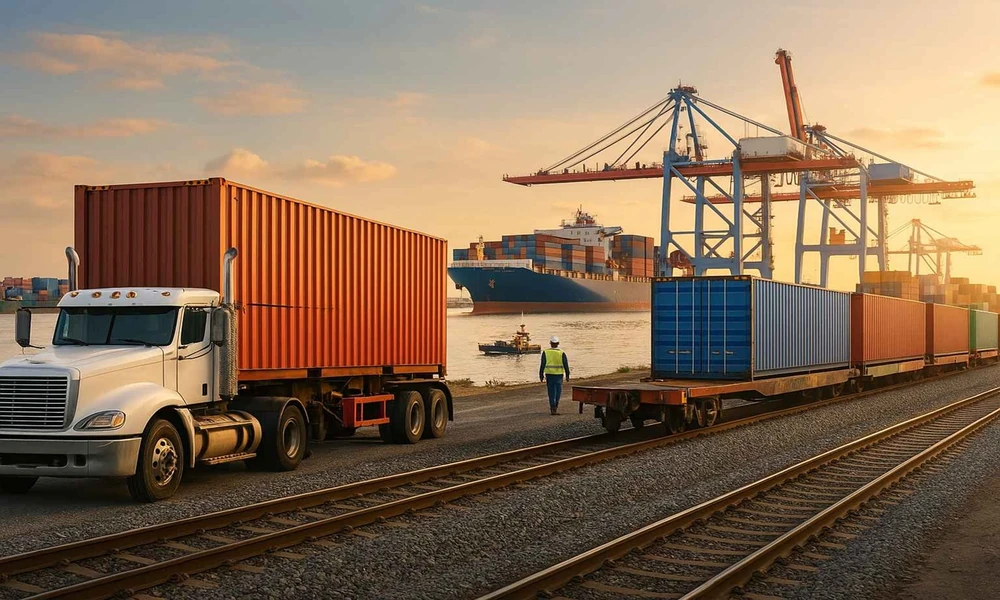
The case for the standard steel box is not that it is clever. It is that it removes work. Every time cargo gets lifted, counted, restacked or repacked, somebody is paid and something gets damaged. Shipping in an intermodal container collapses a dozen handling events into two, one at the shipper and one at the consignee, and almost everything else follows from that. Lower cost, fewer claims, tighter schedules and better security are consequences of the same simplification rather than separate advantages.
Handling Costs Collapse
Break-bulk loading meant gangs of dockers shifting crates, sacks and drums one at a time, with a vessel often spending longer alongside than at sea. Containerisation replaced that with a crane cycle measured in minutes and quay cranes working upwards of thirty boxes an hour. The labour content of moving a tonne of freight fell by an order of magnitude and port turnaround fell with it. That is the structural saving. Everything else in the economics of modern shipping is built on top of it.
Damage and Pilferage Drop Sharply
Cargo gets damaged where it is handled, not where it travels. Removing intermediate touches removes most of the opportunity for crushed cartons, dropped pallets and weather exposure on an open quay. Sealed doors also close off the theft problem that plagued break-bulk operations, where high-value goods sat in open holds and transit sheds for days. Insurers price the difference, and containerised cargo generally attracts lower premiums than the equivalent break-bulk consignment because the claims histories support it.
Fuel per Tonne-Kilometre
Consolidating freight into standard units lets each mode run at its efficient scale. A large vessel moves a tonne of cargo across an ocean on a small fraction of the fuel an aircraft needs for the same work, and rail is markedly more efficient than road over long inland distances. Because the same box transfers between modes without repacking, a shipper can route the long legs onto the efficient modes and keep road for the short ends. The emissions figure tracks the fuel figure closely.
Schedules You Can Plan Around
Fixed dimensions make capacity countable. A terminal knows how many units it lifts per hour, a vessel knows its stow, a train knows its consist, and a shipper can book against published sailings months ahead. Because a standard GP container is interchangeable with every other unit of its size, a carrier can substitute equipment without renegotiating anything. Predictability of that kind is what allows manufacturers to run lean inventory across oceans rather than holding months of stock as insurance against uncertainty.
Security Travels With the Box
A numbered bolt seal is a small thing doing a lot of work. The number is recorded on the bill of lading at stuffing and checked at delivery, so interference between those two points becomes visible without opening the doors. Customs authorities apply the same principle to bonded movements, letting sealed units travel inland under control rather than being examined at the frontier. The chain of custody ends up both documentary and physical, which is why disputes over containerised cargo tend to resolve faster.
One Document Set for the Whole Journey
Before standardisation, each leg of an international movement generated its own paperwork, its own cargo description and its own opportunity for the description to drift. A through bill of lading covering the entire door-to-door movement replaced that with a single reference number a business can quote to a bank, an insurer, a customs authority and a customer. Letters of credit rely on it. Tracking systems key off it. When something goes wrong, the investigation starts from one document rather than from a reconciliation exercise across four. That administrative simplification is easy to overlook and it saves as much staff time as the physical handling saving saves labour on the quay.
Capacity Scales in Whole Units
Growth does not require redesigning anything, only ordering more of the same units. A business shipping two boxes a month and one shipping two hundred use identical equipment, identical documents and identical handling. That removes an entire category of scaling problem, since there is no point at which the packaging strategy has to be rethought. It also keeps cost forecasting straightforward, because rates are quoted per unit and volume discounts apply to something countable rather than to a negotiated estimate of tonnage that both sides then argue about at invoice stage.
Reuse and Residual Value
A steel box built to survive a decade of sea service rarely reaches the end of its useful life at the moment it stops being cargo-worthy. Units retire into static storage, site accommodation, workshops and modular construction, which keeps value in the asset and keeps material out of the scrap stream. For a buyer that matters at the point of purchase, because equipment holding resale value is a different financial proposition from packaging that gets consumed.
The Trade-offs Worth Naming
None of this comes free. Standard dimensions penalise cargo that does not suit the shape, whether in wasted cubic metres or in hiring specialised equipment. Terminals need heavy capital, so origins without them stay expensive to serve. Weight limits bite before volume limits on dense goods. And demurrage and detention charges punish anyone treating the box as free storage. Set against that, the intermodal container still wins for the overwhelming majority of general cargo, and knowing where it does not is what keeps a freight budget honest rather than merely competitive.